What Is the Optimism Bias? Why We Think Bad Things Happen to Other People
Most people expect their own future to go better than average. The optimism bias keeps us motivated and also leaves us under-prepared, so the skill is knowing when to lean on it and when to check it.

In this article
- What is the optimism bias?
- What the research shows
- We update selectively
- It is widespread
- It is debated
- Examples
- Why we have it
- Is it good or bad?
- How to use it wisely
- 1. Check against base rates
- 2. Do a pre-mortem
- 3. Plan for the downside
- 4. Seek feedback from sceptical people
- 5. Attend to bad news actively
- 6. Keep the hope
- 7. Balance with the negativity bias
- A worked example
- Common mistakes
- Frequently asked questions
- What is the optimism bias in simple terms?
- Who discovered the optimism bias?
- Is the optimism bias real?
- Is optimism bias the same as the planning fallacy?
- Is the optimism bias good or bad?
- How do I reduce the optimism bias?
- The bottom line
Key takeaways
- The optimism bias is the tendency to believe we are less likely than others to experience negative events and more likely to experience positive ones.
- Studies show people update their beliefs more readily on good news than on bad news, a pattern linked to how the brain processes information.
- The extent and measurement of the bias are debated, and critics argue some demonstrations can arise from statistical artefacts.
- Moderate optimism supports motivation and wellbeing, but unrealistic optimism can lead to risky health, financial and planning decisions; planning for what could go wrong helps.
Most drivers believe they are better than average. Most smokers know the statistics, and most of them believe those statistics apply more to others. Most of us expect our projects to finish on time, our relationships to last and our health to hold. And yet by definition, we can’t all be above average.
This tilt toward expecting good things is called the optimism bias.
What is the optimism bias?
The optimism bias, also called unrealistic optimism, is the tendency to believe that we are less likely than other people to experience negative events (illness, divorce, accidents, job loss) and more likely to experience positive ones (success, a long life, a happy marriage).
Neil Weinstein’s classic 1980 study asked college students to rate the chances that various events would happen to them compared with their classmates. They rated their own chances of positive events (such as owning a home or living past 80) as above average and negative events (such as having a drinking problem or getting divorced) as below average. Since not everyone can be below average on risk, the pattern points to a systematic bias.
What the research shows
We update selectively
Tali Sharot, Christoph Korn and Raymond Dolan asked participants to estimate their chances of various negative events and then told them the actual average rate. People who learned the real risk was lower than they thought updated their estimates a lot. People who learned it was higher than they thought updated much less. This asymmetry in learning from good versus bad news was linked to reduced activity in a brain region involved in encoding errors when information was worse than expected. In effect, the brain is better at absorbing good news than bad news.
It is widespread
Sharot’s overview suggests the bias appears in many cultures and ages, and it shows up in domains like health, finances and relationships. It tends to be weaker in people with depression, who often estimate risk more accurately, a phenomenon sometimes called “depressive realism,” though that idea is also debated.
It is debated
Adam Harris and Ulrike Hahn argued that some classic demonstrations of unrealistic optimism may be statistical artefacts. For example, if people have imperfect information and regress toward the mean, or if rare events are involved, the data can look like bias even when judgements are rational. Other researchers (such as Shepperd and colleagues) have responded that the bias remains robust when measured carefully. A fair summary: some form of optimism is well supported, but the size and exact causes are still being argued over, so it’s wise to be cautious about strong claims.
Examples
- Health: believing you are less likely than average to get heart disease, or putting off check-ups.
- Safety: skipping a helmet or seat belt, or texting while driving, because “it won’t happen to me.”
- Money: underestimating the chance of job loss, overspending against future income, or taking on risky investments. See how to cope with financial anxiety.
- Projects: assuming plans will go smoothly and finish early. See what is the planning fallacy.
- Relationships: thinking that divorce statistics apply to other couples.
- Business: founders who expect to beat the odds. See what is survivorship bias.
Why we have it
- Motivation and mood: expecting good outcomes helps us act, persist and feel better.
- Selective attention and memory: we focus on favourable information and remember it better.
- Sense of control: we overestimate our ability to influence outcomes.
- Self-enhancement: we like to see ourselves positively. See what is the self-serving bias.
- Representativeness: we compare ourselves to stereotypes of people who suffer misfortune (“I’m not that type”).
- Not enough personal information about others: we know our own good habits, not other people’s.
Is it good or bad?
Both. A realistic-but-hopeful outlook supports resilience, effort and wellbeing. Research on optimism links it with better coping and persistence. But unrealistic optimism can lead to:
- skipped screenings, vaccinations or safety measures,
- under-saving and over-borrowing,
- underestimating time, cost and risk,
- poor preparation for setbacks,
- being blindsided when things go wrong.
The goal is not pessimism. It is balanced optimism: hope plus preparation.
How to use it wisely
1. Check against base rates
Ask: What happens to people like me? Look up real rates for illness, project overruns, business survival or financial shortfalls. Then ask why you would be different, and whether the reasons are real.
2. Do a pre-mortem
Imagine the plan has failed and write down why. This brings the bad-news pathway online and surfaces risks. See how to make decisions when you’re unsure.
3. Plan for the downside
Build in buffers: extra time, savings, backup options, insurance. Optimistic about the outcome, prepared for the process.
4. Seek feedback from sceptical people
Ask someone who will tell you honestly what could go wrong. Because we update less on bad news, we benefit from a voice that brings it up.
5. Attend to bad news actively
When you receive discouraging data, pause and ask: What would I do if this were true? Write down your original estimate and revise it.
6. Keep the hope
Preparing for risk doesn’t mean expecting failure. Hold both: “I expect this to go well, and I have a plan if it doesn’t.” See how to build resilience after a setback.
7. Balance with the negativity bias
We also have a pull toward bad news in certain contexts. See what is negativity bias. The aim is accurate perception, not a permanent tilt either way.
A worked example
Sam plans to launch a side business while working full time.
- Base rates: he looks up how many small businesses survive the first two years; it’s a sobering figure.
- Pre-mortem: he imagines failure in a year and lists causes: underestimated time, too few customers, cash flow.
- Downside plan: he saves six months of expenses and sets a stop-loss point.
- Sceptical feedback: an experienced friend asks tough questions about pricing and customers.
- Update on bad news: when the first month’s sales are lower than predicted, he revises his forecast instead of explaining it away.
- Hope: he stays committed, with clear checkpoints.
Sam still feels optimistic, but his optimism now has a safety net.
Common mistakes
- Assuming you’re immune to the bias. Everyone has some.
- Swinging to pessimism. Accuracy is the aim.
- Ignoring base rates because “I’m different.” Show why.
- Treating warnings as negativity. They are information.
- Using optimism to avoid preparation. Hope isn’t a plan.
- Overstating the research. It is a robust but debated phenomenon.
Frequently asked questions
What is the optimism bias in simple terms?
Believing that good things are more likely to happen to you than to others, and bad things less so.
Who discovered the optimism bias?
Neil Weinstein described it in 1980. Tali Sharot has studied it extensively with neuroscience.
Is the optimism bias real?
Evidence supports it, but its size and measurement are debated.
Is optimism bias the same as the planning fallacy?
The planning fallacy is a specific case, underestimating the time and cost of tasks. Optimism bias is broader.
Is the optimism bias good or bad?
Moderate optimism helps motivation and wellbeing. Unrealistic optimism can lead to risky decisions.
How do I reduce the optimism bias?
Use base rates, run a pre-mortem, plan for the downside and ask for honest feedback.
The bottom line
The optimism bias is the brain’s tendency to expect the best for ourselves and to update more readily on good news than on bad. It fuels motivation and also under-preparation. Keep your hope, check it against base rates, imagine the failure, build buffers and listen to the sceptics. That is optimism with its eyes open.
References & sources
- Unrealistic optimism about future life events . Journal of Personality and Social Psychology, 39(5), 806–820 (Weinstein), 1980.
- How unrealistic optimism is maintained in the face of reality . Nature Neuroscience, 14(11), 1475–1479 (Sharot, Korn & Dolan), 2011.
- The optimism bias . Current Biology, 21(23), R941–R945 (Sharot), 2011.
- Unrealistic optimism about future life events: A cautionary note . Psychological Review, 118(1), 135–154 (Harris & Hahn), 2011.
This article is for general information and education. It is not medical advice and cannot replace care from a qualified professional. Read our disclaimer.
Related reading

What Is the Planning Fallacy? Why Everything Takes Longer Than You Think
We underestimate how long tasks will take even when we know similar tasks ran late before. The planning fallacy is a prediction habit, and an 'outside view' of how things usually go corrects most of it.
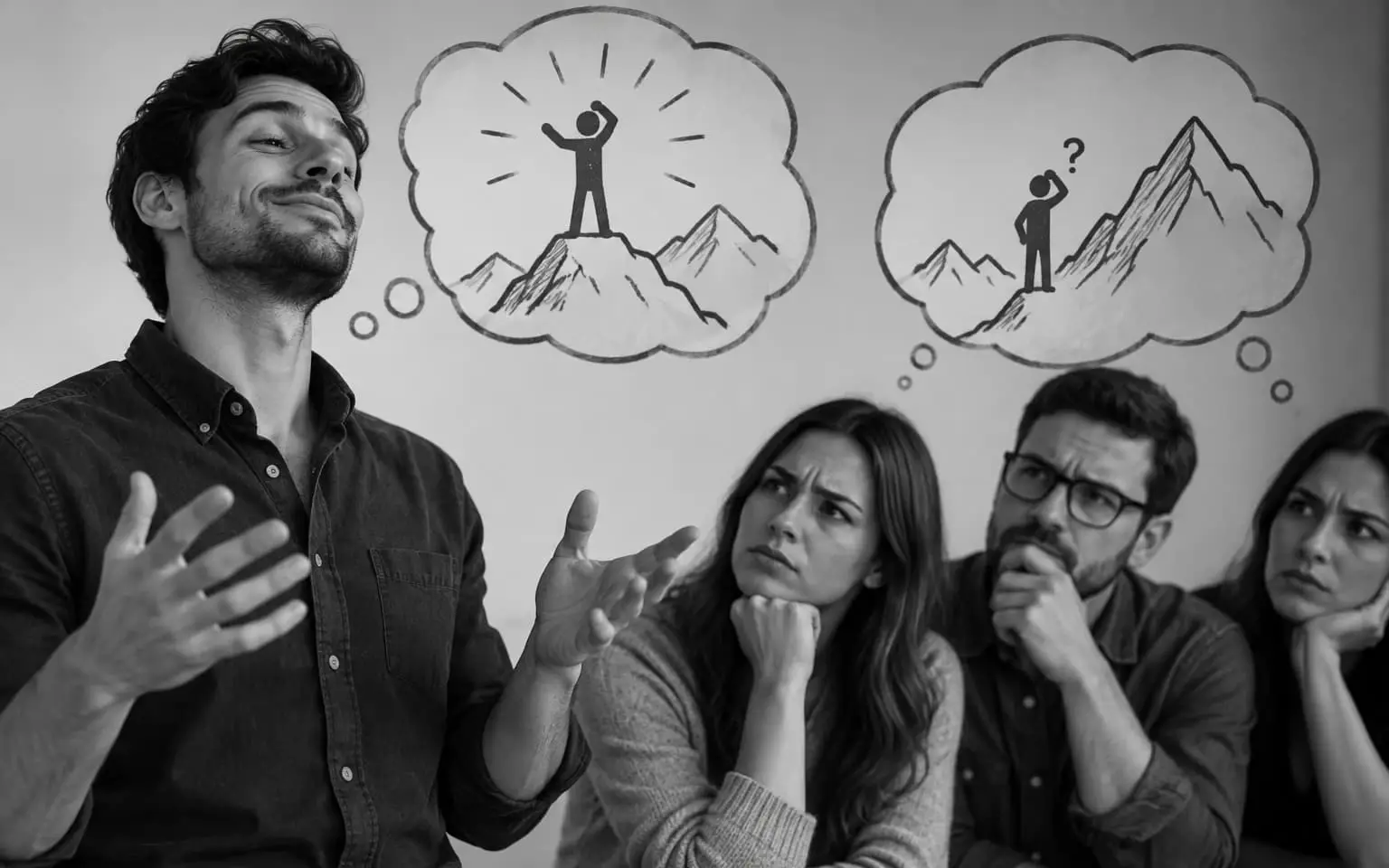
What Is the Dunning-Kruger Effect? Meaning, Examples and Common Myths
It is one of the most quoted ideas in psychology and one of the most misunderstood. Here is what Dunning and Kruger actually found, what critics say, and what it means for you.
What Is Negativity Bias? Why Bad Feels Stronger Than Good
A single harsh comment can undo an entire day of good news. That's not oversensitivity; it's a well-documented feature of how minds process threat versus reward. Here's how it works.
More in Psychology
All Psychology →
Editor’s picks



The Clear Mind letter
One considered essay, now and then.
No streaks, no urgency. A short note when we publish something worth your attention.