Child Scared to Go to School? What to Say and How to Help
Tears at the door, stomachaches on school mornings, 'I'm not going.' School fear is common and treatable. Here is how to respond calmly, what to say, and when to involve professionals.
In this article
- Why is my child scared to go to school?
- Signs of school anxiety
- What to say to a child who is scared of school
- Helpful phrases
- Phrases to avoid
- 9 practical steps for parents
- 1. Stay calm yourself
- 2. Find out the reason, gently
- 3. Talk to the school early
- 4. Rule out medical causes
- 5. Create a predictable morning and evening routine
- 6. Build a short goodbye ritual
- 7. Teach one or two coping tools
- 8. Encourage gradual steps, and avoid full avoidance
- 9. Praise bravery, not just results
- A worked example
- Do practice runs and arrange a hand-off
- Look after your own response, and avoid blame
- Common mistakes
- When to seek professional help
- Frequently asked questions
- Why is my child suddenly scared to go to school?
- Should I make my child go to school when they’re scared?
- What is school refusal?
- How long does school anxiety last?
- Why does my child get stomachaches before school?
- What if my child won’t tell me what’s wrong?
- The bottom line
Key takeaways
- School fear has many possible causes, including separation, social worries, academic pressure, bullying and general anxiety, so the first task is to understand the reason.
- Validating the feeling while staying calm and confident that your child can cope works better than either dismissing fear or letting them stay home.
- Avoidance relieves anxiety in the short term and strengthens it over time, so gradual, supported return is usually the goal.
- Persistent refusal, physical complaints without a medical cause or signs of bullying or depression warrant talking to the school and a health professional.
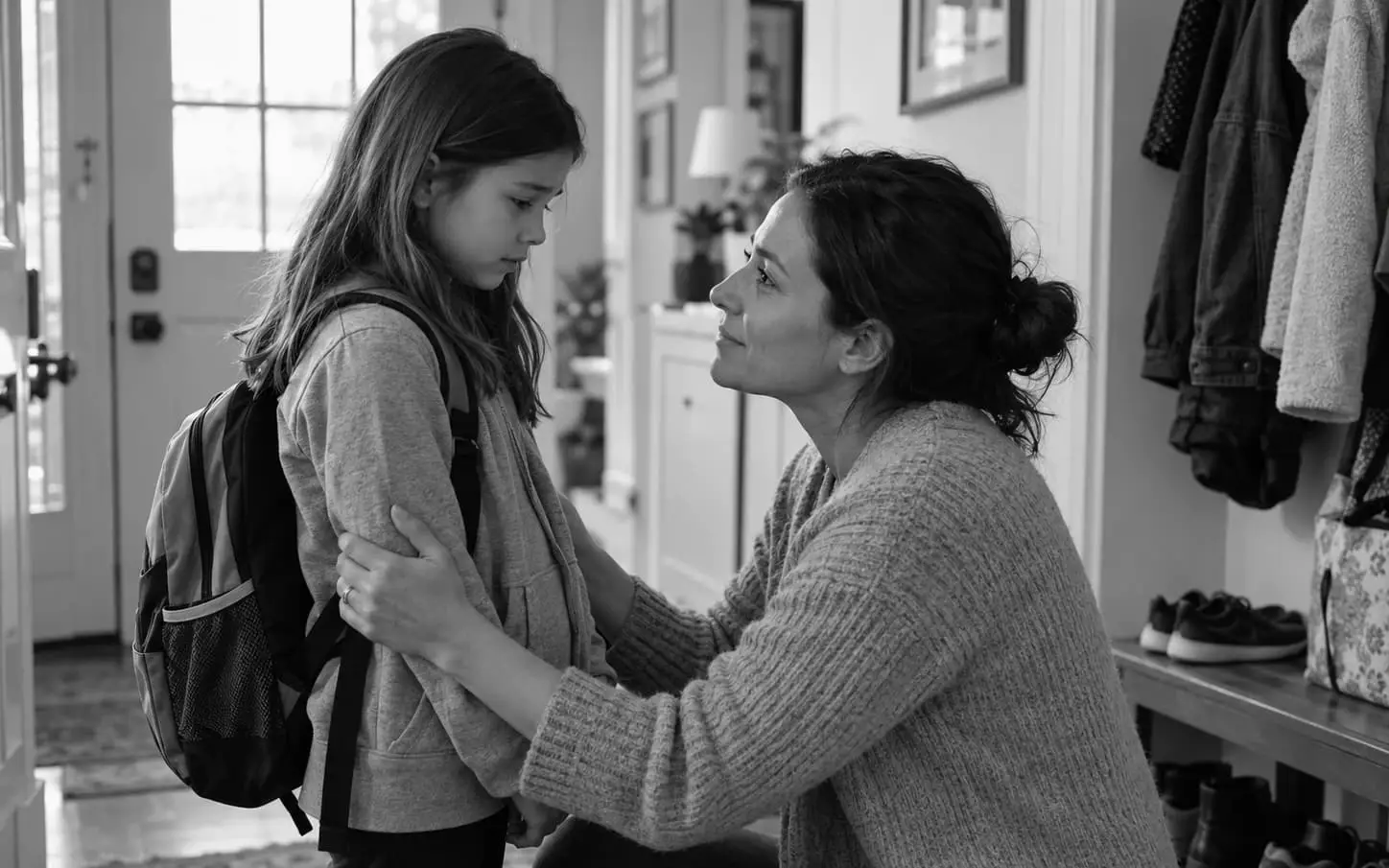
The alarm goes off, and your child is already crying. Or they suddenly have a stomachache. Or they cling to the car door and beg, “Please don’t make me go.” You are late, you are worried, and you have no idea whether to hug them or push them through the gates.
If your child is scared to go to school, you are far from alone. School fear is one of the most common worries parents bring to paediatricians and counsellors, and in most cases it can be eased with a calm, consistent approach. This guide explains what may be behind it, what to say, and what to do step by step.
Why is my child scared to go to school?
Fear of school is a symptom, not a diagnosis. Something is making school feel unsafe or overwhelming. Common reasons include:
- Separation anxiety. Especially in younger children, or after illness, a move, a new sibling or time at home.
- Social worries. Friendship trouble, feeling left out, fear of being laughed at or of speaking in class.
- Bullying. Always consider this, even if your child hasn’t mentioned it.
- Academic pressure or learning difficulties. Struggling with reading, maths, attention or language can make every school day feel like failing.
- Fear of specific situations. Loud cafeterias, changing rooms, tests, presentations, the bus.
- A difficult teacher or a change in routine. New class, new school or new teacher.
- General anxiety. Some children worry a lot across many areas. See why anxiety feels physical for how worry shows up in the body.
- Big life events. Family conflict, illness, loss or divorce can show up as school fear.
- Sensory or neurodevelopmental needs. Autism, ADHD and sensory sensitivities can make the school day exhausting.
Researchers who study school refusal often group the reasons into four broad functions: avoiding something distressing at school, escaping social or evaluation situations, getting attention from caregivers, or gaining rewards outside school. Understanding the function helps you choose the right response.
Signs of school anxiety
Look for patterns, especially on school mornings or Sunday evenings:
- stomachaches, headaches, nausea or “feeling sick” that improves on weekends,
- crying, tantrums or clinging before school,
- trouble sleeping or nightmares,
- asking many “what if” questions,
- reluctance to talk about school,
- irritability, withdrawal, or sudden drop in grades,
- pleading to stay home or refusing to get dressed.
Physical complaints are real, even when there is no medical cause. Children often can’t yet explain worry in words, so the body speaks first.
What to say to a child who is scared of school
The aim is to validate the feeling and express confidence, without agreeing that school is dangerous.
Helpful phrases
- “I can see you’re really scared. That sounds hard.”
- “Lots of kids feel nervous about school. It makes sense.”
- “I’m not sure what’s going on, but I want to understand. Can you tell me about the hardest part?”
- “I know it feels big. I also know you can do hard things, and I’ll help.”
- “What’s one thing that would make tomorrow a little easier?”
Phrases to avoid
- “There’s nothing to be scared of.” (Feels dismissive.)
- “Stop being silly.” (Adds shame.)
- “Okay, you can stay home.” (Reinforces avoidance.)
- “What’s wrong with you?” (Feels like blame.)
- Long lectures or repeated reassurance loops.
For more on helping kids find words for their feelings, see helping children name big feelings.
9 practical steps for parents
1. Stay calm yourself
Children read your nerves. Speak slowly, keep your voice warm, and move steadily through the routine. If you are dreading mornings, try calming your own body first (see how to calm anxiety fast).
2. Find out the reason, gently
Choose a relaxed moment, not the school-door moment: in the car, while drawing, before bed. Ask open questions: “What’s the worst part of the day? Who do you sit with? What happens at lunch?” Younger children may answer better through drawing or play. Keep a note of patterns: which days, which subjects, which times.
3. Talk to the school early
Contact the teacher or school counsellor. Ask what they see, whether there have been changes, and what support is possible: a check-in person, a “safe space”, a buddy, a gradual start, adjusted workload. A united home-school approach usually works best. If bullying is a possibility, ask directly and document what you learn.
4. Rule out medical causes
If your child has ongoing stomachaches, headaches or sleep problems, visit a paediatrician. Then keep in mind: a normal check-up doesn’t mean the symptoms aren’t real, it means anxiety is more likely involved.
5. Create a predictable morning and evening routine
Predictability is calming. Prepare bags and clothes the night before, keep wake-up times consistent, allow enough time and use a visual checklist for younger children. Keep mornings low on rushing and screens.
6. Build a short goodbye ritual
Long or repeated goodbyes can raise anxiety. Use a short, warm, predictable routine: a hug, a phrase (“See you at 3:30, I love you”), a special handshake. Then go. Lingering or sneaking off tends to backfire.
7. Teach one or two coping tools
Practise them at home when calm:
- Slow breathing: “smell the flower, blow the candle”.
- Grounding: name five things you can see.
- A brave phrase: “I can feel scared and still do this.”
- A comfort item such as a small keepsake, or a note in the pocket.
8. Encourage gradual steps, and avoid full avoidance
Staying home relieves fear in the moment but teaches the brain that school really is dangerous, so the fear tends to grow. Where possible, keep attendance going with support. If your child has been away for a while, plan a step ladder, such as: drive past the school; go inside briefly; attend the first lesson; a half day; a full day. Celebrate every step. Child-anxiety treatments follow the same principle of gradual, supported exposure to feared situations.
9. Praise bravery, not just results
“You walked in even though you were scared, that was brave” matters more than “good job”. Notice effort and small wins. A simple reward chart can help younger kids, if rewards are small and linked to brave steps.
A worked example
Leo, 8, has stomachaches every Monday and cries at the school gate.
- Understand: he tells his mum that “the recess game is scary because kids run and shout”.
- School: she talks to his teacher, who agrees to pair him with a friendly classmate and offer a quiet activity at recess twice a week.
- Routine: bags packed the night before; a 30-second goodbye ritual.
- Tools: Leo practises “flower and candle” breathing at home.
- Ladder: week one, join the group for five minutes; week two, ten minutes.
- Outcome: stomachaches ease over a few weeks; Monday mornings become calmer.
Do practice runs and arrange a hand-off
Familiarity lowers fear. Before a new school year or after a long absence:
- Visit the school when it is quiet, walk the route, find the classroom, the toilets and where you’ll meet at the end of the day.
- Meet the teacher briefly, if possible, so your child has one face they know.
- Rehearse the morning on a weekend: alarm, breakfast, bag, the walk or drive.
- Arrange a hand-off: ask whether a named adult, such as a teacher, teaching assistant or counsellor, can greet your child at the door and take them in. A friendly classmate as a “buddy” can help too.
- Agree a plan for the wobbly moment, such as a signal to the teacher and a quiet place to reset for a few minutes, so your child knows there is a way to cope.
Look after your own response, and avoid blame
Anxiety is contagious. If you are dreading mornings, your child will feel it, so plan your own calming routine and get support from your partner, a friend or your GP. Try to keep out of shame and blame, both toward your child and yourself. A “both/and” stance helps: “You’re scared, and you can do this with my help.” Think of yourself as the coordinator of a small team that includes your child, the school and, where needed, a clinician.
Common mistakes
- Allowing regular stays at home. It provides short-term relief but strengthens avoidance.
- Over-reassuring. Answering every “what if” can keep the loop alive.
- Ignoring the physical symptoms. They are real, even if not medical.
- Assuming it is “just” separation anxiety. Check for bullying, learning difficulties and sensory needs.
- Threats or punishment. Fear grows in the face of pressure.
- Delaying action. Early support is easier than fixing long absence.
When to seek professional help
Consider talking to your GP, paediatrician or a child psychologist if:
- the fear lasts more than a few weeks or is getting worse,
- your child is missing a lot of school,
- physical symptoms are frequent,
- you suspect bullying, learning difficulties or trauma,
- your child seems very sad, withdrawn, hopeless or talks about self-harm,
- anxiety affects sleep, friendships or family life.
Cognitive-behavioural therapy is a well-supported treatment for childhood anxiety, and large trials, including a study published in the New England Journal of Medicine, found it effective alone or combined with medication in some cases. Parent-focused programmes can also help. The American Academy of Pediatrics guide on school avoidance offers additional practical advice. If your child is in immediate danger, contact your local emergency number or, in the United States, call or text 988. See our disclaimer.
If the worry is mostly about peers, how to help a shy child make friends offers gentle, practical steps.
Evenings can feed morning dread; see how to get a child to do homework without a fight.
Calmer mornings help; see how to make school mornings less stressful.
Frequently asked questions
Why is my child suddenly scared to go to school?
A recent change such as a new teacher, friendship problem, bullying, illness, a family event or academic difficulty is common. Sudden change deserves a gentle conversation and a check with the school.
Should I make my child go to school when they’re scared?
In most cases, yes, with support. Consistent attendance, together with steps to address the cause, helps anxiety fall over time. If bullying, safety concerns or severe distress are involved, consult the school and a professional.
What is school refusal?
It is a persistent difficulty attending school because of emotional distress, often anxiety. It differs from truancy, where a child hides absence from parents.
How long does school anxiety last?
It varies. Mild worry may ease in days or weeks. Persistent cases can take months, especially when avoidance has built up, and improve with the right support.
Why does my child get stomachaches before school?
Anxiety triggers real bodily responses, including nausea and stomach pain. If medical checks are clear, anxiety is a likely explanation.
What if my child won’t tell me what’s wrong?
Try indirect routes such as drawing, stories or side-by-side chats, and ask the teacher for observations. Some children can’t name the reason yet.
The bottom line
A scared child needs two things at once: to know you understand, and to know you believe they can do it. Listen, find the cause, work with the school, keep routines steady and take small brave steps. Tonight, ask one open question, “What’s the hardest part of the school day?”, and listen without fixing.
References & sources
- School Avoidance: Tips for Concerned Parents . HealthyChildren.org, American Academy of Pediatrics.
- Managing Back-to-School Anxiety . Child Mind Institute.
- A preliminary analysis of a functional model of assessment and treatment for school refusal behavior . Behavior Modification, 14(3), 340–366, 1990.
- Cognitive behavioral therapy, sertraline, or a combination in childhood anxiety . New England Journal of Medicine, 359(26), 2753–2766, 2008.
- Parent-based treatment as efficacious as cognitive-behavioral therapy for childhood anxiety: A randomized noninferiority study of supportive parenting for anxious childhood emotions . Journal of the American Academy of Child & Adolescent Psychiatry, 59(3), 2020.
This article is for general information and education. It is not medical advice and cannot replace care from a qualified professional. Read our disclaimer.
Related reading

Helping Children Name Big Feelings: A Practical Guide for Parents
Children learn to manage emotions by first learning to name them. Simple, everyday ways parents and carers can help build emotional understanding at any age.

How to Handle Toddler Tantrums: What to Do in the Moment (and After)
A meltdown in the supermarket aisle is not a parenting failure. It is a small brain with big feelings. Here is what is going on, what helps in the moment, and how to make tantrums less frequent.

How to Talk to Your Teenager So They Will Actually Listen: 10 Tips
Somewhere between twelve and sixteen, conversations turned into 'fine' and 'nothing'. Here is what is going on behind the silence, and how to keep the door open.
More in Parenting
All Parenting →

Editor’s picks



The Clear Mind letter
One considered essay, now and then.
No streaks, no urgency. A short note when we publish something worth your attention.