Why Anxiety Feels So Physical (and What Your Body Is Trying to Do)
A racing heart, tight chest and knotted stomach are part of the body's alarm system. Here's why anxiety shows up physically and what can help settle it.
In this article
- Your body’s built-in alarm
- Common physical signs
- Why the sensations can make it worse
- What tends to help
- What is happening, system by system
- Why the same sensations can mean excitement or dread
- A two-minute reset
- Symptoms that need medical attention
- A worked example
- Common mistakes
- When to talk to someone
- Frequently asked questions
- Why does anxiety make my heart race?
- Can anxiety cause physical symptoms without feeling anxious?
- How can I tell the difference between anxiety and a heart problem?
- Why does anxiety cause stomach problems?
- How long do physical anxiety symptoms last?
- When should I see a doctor about physical anxiety symptoms?
- The bottom line
Key takeaways
- Physical anxiety symptoms are the body's alarm system doing its job — just at the wrong moment.
- Unpleasant does not mean dangerous; understanding the sensations can lower the fear of them.
- Slow exhalation, movement and grounding help the body signal "safe" to itself.
- New, severe or unexplained physical symptoms deserve a medical check, not self-diagnosis.
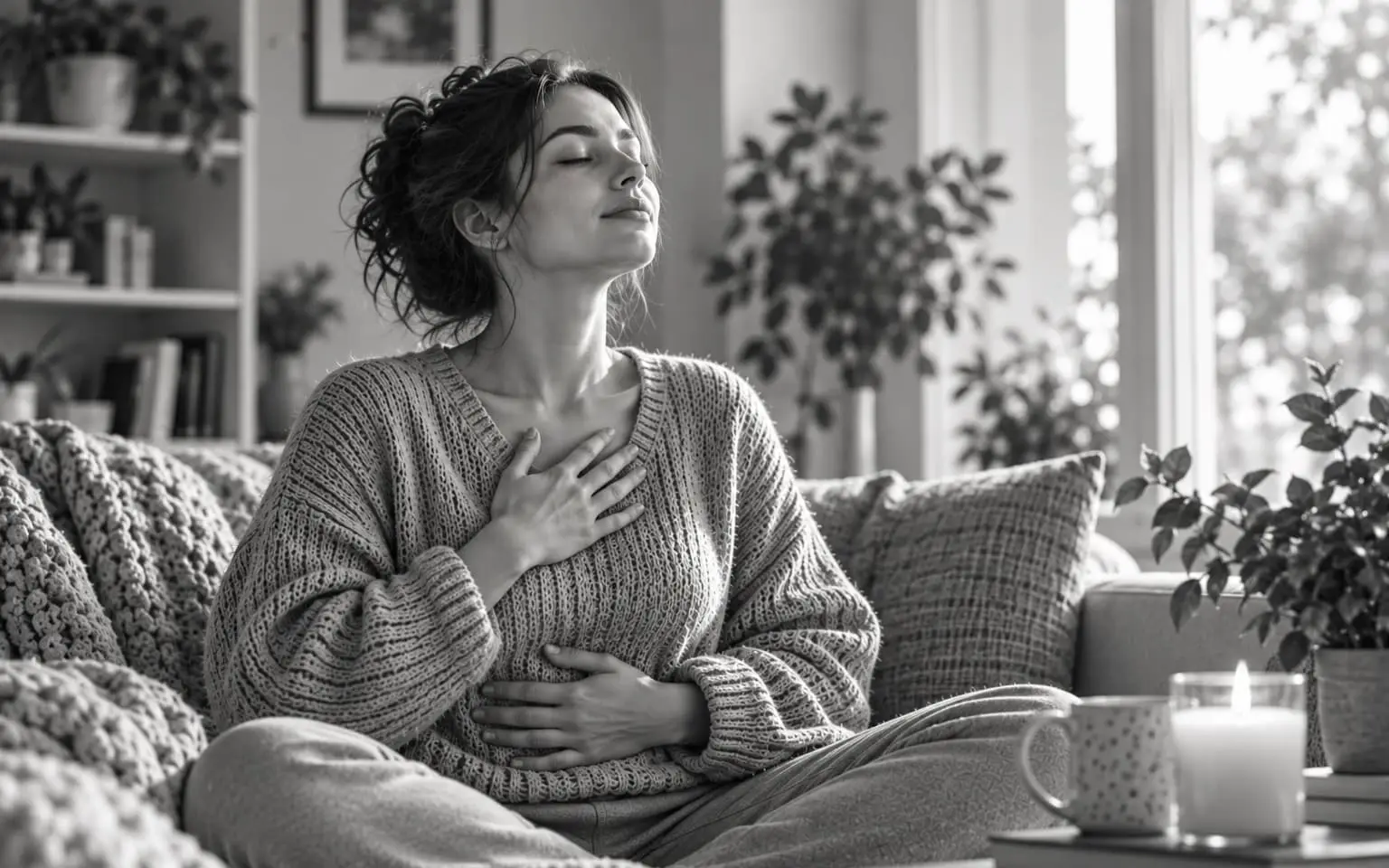
For many people, anxiety doesn’t start as a thought at all. It starts as a sensation: a heartbeat you can suddenly feel, a tight throat, a stomach that won’t settle. It is easy to worry that something is physically wrong — and that worry adds fuel.
Your body’s built-in alarm
When the brain senses possible threat, it prepares the body to act. Heart rate rises to move blood to the muscles. Breathing quickens. Digestion slows. Muscles tense. This is the familiar “fight or flight” response, and it is useful when the danger is real.
The trouble is that the alarm doesn’t distinguish well between a car swerving toward you and an unread email from your manager. Modern worries are mostly mental, but the response is bodily.
For a closer look at one of the most common patterns, read why you wake up anxious.
Common physical signs
People describe anxiety in different ways. Some common experiences include:
- A pounding or fluttering heartbeat
- Shallow, fast breathing or a feeling of not getting enough air
- Tight muscles, especially in the neck, jaw and shoulders
- Stomach discomfort, nausea or changes in appetite
- Dizziness, trembling or sweating
- Trouble sleeping or feeling wired but tired
None of these, on its own, tells you the cause. That is why a check-up matters if symptoms are new, severe or worrying.
Why the sensations can make it worse
Anxiety has a feedback loop. You notice a racing heart, you interpret it as danger, the alarm gets louder, and the heart speeds up further. Learning that these sensations are unpleasant but not harmful can weaken the loop.
When the fear of a symptom becomes the main worry, it is worth reading about health anxiety, and about what to do in the middle of a panic attack.
What tends to help
Lengthen the exhale. Breathing in gently through the nose and out slowly through the mouth, with the out-breath a little longer than the in-breath, is a simple way to help the body settle.
Ground yourself in the room. Name five things you can see and three you can hear. It brings attention back to the present.
Move. Walking, stretching or shaking out your arms gives the stress response somewhere to go.
Look after the basics. Regular sleep, meals and less caffeine won’t cure anxiety, but they lower its baseline.
If you want a fuller toolkit, how to calm anxiety fast lays out nine techniques and how to choose between them.
What is happening, system by system
Heart and blood vessels. Adrenaline speeds the heart and tightens blood vessels so more blood reaches large muscles. You may feel a pounding pulse, flushing or cold hands, because blood is diverted from the skin and gut.
Breathing. Anxiety often makes breathing faster and shallower. Over-breathing lowers carbon dioxide in the blood, which can cause dizziness, tingling in the hands or lips and a feeling of air hunger. Those sensations are harmless, though frightening, and they ease when breathing slows.
Digestion. The gut has its own dense network of nerves and is closely linked with the brain. Stress can cause nausea, cramps, a “knot” in the stomach, diarrhoea or loss of appetite.
Muscles. Muscles tense to prepare for action. Long periods of anxiety can cause tension headaches, a stiff neck and jaw clenching.
Senses and temperature. Pupils widen, hearing sharpens and sweating increases to cool the body for action.
Why the same sensations can mean excitement or dread
A racing heart before a first date and a racing heart before a medical result feel almost identical. What differs is the interpretation. Researchers who study interoception, the brain’s reading of internal body signals, suggest that anxious people tend to be more alert to those signals and more likely to read them as dangerous.
A related idea is anxiety sensitivity: the belief that anxiety sensations themselves are harmful, as in “my heart racing means I’m having a heart attack.” People high in anxiety sensitivity are more likely to develop panic and heightened fear. The encouraging part is that this belief can be changed through understanding and gradual practice, which is a core element of cognitive-behavioural therapy.
Studies by Alison Wood Brooks found that telling yourself “I am excited” before a stressful task, instead of trying to calm down, improved performance for many people, because the body’s arousal was the same and the label made it useful.
A two-minute reset
- Feet and floor. Press your feet down and feel the support under you (10 seconds).
- Slow exhale. Breathe in through your nose for four, out through pursed lips for six to eight. Repeat for one minute.
- Name it. Say quietly: “This is anxiety. It is uncomfortable and it will pass.”
- Look around. Name five things you can see.
- Move. Walk, stretch or shake out your hands.
Symptoms that need medical attention
Anxiety can cause many physical sensations, but some symptoms should be checked promptly. Seek urgent medical help if you have chest pain that spreads to the arm, jaw or back, shortness of breath at rest, fainting, sudden weakness on one side of the body, confusion or severe symptoms that are new for you. If you are unsure, it is always reasonable to be checked. See also a doctor for symptoms that are persistent, getting worse or unexplained, since thyroid problems, anaemia, heart rhythm issues, medication effects and other conditions can mimic anxiety.
A worked example
Tom feels his heart pounding and his hands tremble before a presentation, and he starts thinking, “Something is wrong with me.”
- Understand: he reminds himself that the pounding is adrenaline preparing him to perform.
- Slow exhale: he breathes in for four and out for seven, five times.
- Reframe: “I’m excited and nervous.”
- Ground: he feels his feet and holds the lectern.
- Move: he walks to the water cooler first.
His heart rate stays high for a few minutes, but the fear of the sensation fades, which is what lets the sensation fade, too.
Common mistakes
- Fighting the sensations. Resisting tends to make them louder.
- Checking your pulse repeatedly. It keeps attention on the alarm.
- Avoiding every situation that causes symptoms. It shrinks your life and strengthens the fear.
- Using caffeine and alcohol to cope. Both can worsen anxiety symptoms.
- Assuming it is “just anxiety” for new, severe symptoms. Get a medical check.
When to talk to someone
If anxiety is frequent, intense or getting in the way of daily life, a doctor or mental health professional can help identify what is happening and suggest options. Effective support exists, and you don’t have to wait until things are unbearable.
Long-running tension, exhaustion and dread can also be a sign of burnout, which is worth recognising early.
If tension lingers even when nothing seems wrong, see why can’t I relax even when nothing is wrong.
If the anxiety seems to have no clear trigger at all, see why do I feel anxious for no reason.
A common version of body-driven anxiety shows up the morning after drinking; see how to deal with hangxiety.
One common, fixable trigger for these sensations is covered in does caffeine cause anxiety.
Frequently asked questions
Why does anxiety make my heart race?
When the brain senses a threat, it releases adrenaline, which speeds the heart to send blood to the muscles. It is the body preparing to act, even if the threat is a worry, not a danger.
Can anxiety cause physical symptoms without feeling anxious?
Yes. Some people notice body symptoms such as tension, stomach trouble or fatigue before, or without, feeling mentally anxious.
How can I tell the difference between anxiety and a heart problem?
You cannot always tell from sensations alone. If you have chest pain that spreads, shortness of breath at rest, fainting or new severe symptoms, get medical help promptly. A doctor can check your heart and other causes.
Why does anxiety cause stomach problems?
The gut and brain are closely connected through nerves and hormones. Stress can speed up or slow down digestion, causing nausea, cramps or diarrhoea.
How long do physical anxiety symptoms last?
Individual surges usually peak within minutes and fade within about 20 to 30 minutes. Background tension can persist longer if stress continues.
When should I see a doctor about physical anxiety symptoms?
If symptoms are new, severe, persistent or interfere with daily life, or if you are unsure of the cause. Treatment for anxiety is effective, and a doctor can also rule out other conditions.
The bottom line
Physical anxiety is your body’s alarm doing its job at the wrong moment. The sensations are uncomfortable but not dangerous in themselves. Lengthen the exhale, ground yourself, move, reframe what you feel and look after the basics. Get anything new or severe checked by a doctor.
References & sources
- An insular view of anxiety . Biological Psychiatry, 60(4), 383–387 (Paulus & Stein), 2006.
- Anxiety sensitivity, anxiety frequency and the prediction of fearfulness . Behaviour Research and Therapy, 24(1), 1–8 (Reiss, Peterson, Gursky & McNally), 1986.
- Get excited: Reappraising pre-performance anxiety as excitement . Journal of Experimental Psychology: General, 143(3), 1144–1158 (Brooks), 2014.
- Anxiety disorders . National Institute of Mental Health.
- Anxiety disorders (fact sheet) . World Health Organization.
This article is for general information and education. It is not medical advice and cannot replace care from a qualified professional. Read our disclaimer.
Related reading

Does Caffeine Cause Anxiety? What the Research Says and How Much Is Too Much
Caffeine does not cause an anxiety disorder in most people, but it can produce the same sensations and make existing anxiety worse. Knowing your own threshold is the useful part.
How to Stop a Panic Attack: 9 Steps to Take in the Moment
Your heart is pounding, you can't catch your breath and you're sure something is terribly wrong. A panic attack is frightening, but it is not dangerous, and you can get through it.

How to Overcome the Fear of Being Alone: 8 Steps to Feel Safe in Solitude
Fear of being alone is not a flaw. It is an old social instinct that can grow louder than it needs to. The way out is not to stop needing people, but to learn that your own company is survivable, and even good.
More in Anxiety & Stress
All Anxiety & Stress →


Editor’s picks

The Clear Mind letter
One considered essay, now and then.
No streaks, no urgency. A short note when we publish something worth your attention.